"Dream, Dream, Dream! Conduct these dreams into thoughts, and then transform them into action."
- Dr. A. P. J. Abdul Kalam
"Dream, Dream, Dream! Conduct these dreams into thoughts, and then transform them into action."
- Dr. A. P. J. Abdul Kalam
20 Feb 2026
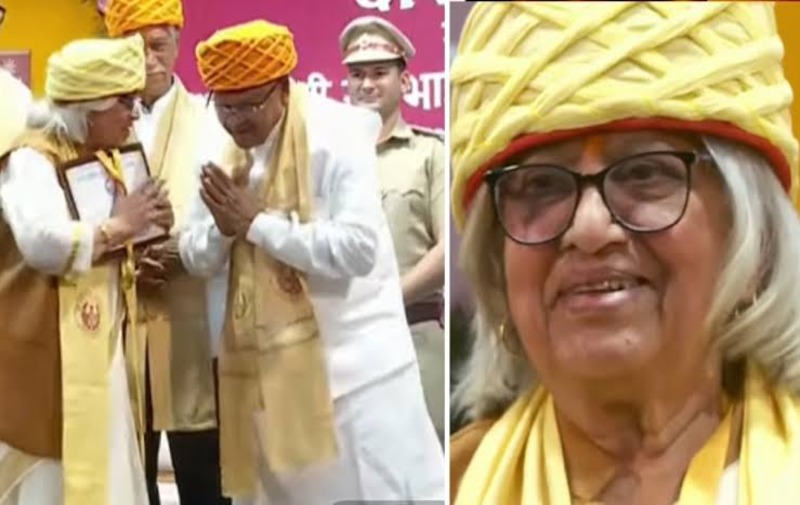
Convocation ceremonies usually celebrate young achievers stepping into the world with fresh degrees. But at the recent ceremony of Devi Ahilya Vishwavidyalaya in Indore, the loudest applause was reserved for someone who had already lived through decades of experience. Seventy-eight-year-old Sushma Moghe walked onto the stage not just as a student but as a symbol of courage and lifelong curiosity. Honored with a gold medal in MA Marathi literature by Governor Mangubhai Patel, she quietly shattered one of society’s strongest myths—that education belongs only to the young.
For many, retirement marks a slowing down of life. For Sushma Moghe, it became the beginning of a new chapter. After stepping away from her professional responsibilities, she felt a sense of emptiness. The routine was gone, the urgency had faded, and the days seemed longer. Instead of accepting that silence, she chose to fill it with books. She enrolled in an MA program in Marathi, her mother tongue and her lifelong love. What started as a personal decision to stay mentally active soon turned into a remarkable academic journey. “I didn’t know that I could pursue an MA in Marathi at this age,” she shared with a news agency. “When I found out, I decided to make the most of this opportunity.” Her words reflect something deeper than ambition; they reflect rediscovery.
Winning a gold medal is never easy. It demands discipline, dedication, and consistent hard work. To top an MA program at 78 requires not just intelligence but extraordinary determination. Competing alongside much younger classmates, Moghe attended lectures, completed assignments, and prepared for exams with seriousness and commitment. She adapted to both online and offline modes of learning, something that even younger students sometimes struggle with.
Expressing gratitude toward her professors, she said they supported her fully and ensured she never felt left behind. The classroom did not see her age first; it saw her passion. Her achievement was not only personal. It became institutional pride. Vice Chancellor Dr. Rakesh Singhai described her success as a proud moment for the university. In a convocation where two scholars received D.Litt. degrees, 220 were awarded PhDs, and 217 meritorious students received gold and silver medals, Moghe’s story stood out because it carried a powerful human message.
For Sushma Moghe, Marathi is not just a subject; it is emotion. It is identity. It is memory. Even after earning her degree, she has continued her literary journey by translating works of well-known Hindi authors into Marathi. Her connection to literature goes beyond marks and medals. It is about preserving language, sharing stories, and building bridges between cultures. In an age where screens often dominate attention, her dedication to books reminds us of the timeless comfort of reading and writing.
Literature gave her purpose when she needed it most, and she, in turn, gives literature her devotion. Society often associates aging with slowing down. There is an unspoken expectation that after a certain age, one should step back from challenges and ambitions. Moghe’s story challenges that assumption completely. At 78, she was not trying to prove anything to the world. She was simply trying to learn. And that simplicity makes her achievement even more inspiring.
Sushma Moghe’s advice is clear and practical “Make good use of your free time and keep learning continuously. The world offers endless opportunities to learn; you just need to recognize them.” In today’s fast-paced world, where people often complain about not having enough time, her message feels both gentle and powerful. She reminds us that time is not the problem; intention is. Her story also strengthens the idea that universities are not just spaces for the young. They are spaces for seekers regardless of age. Education is not a race to finish early. It is a lifelong relationship with knowledge. In a world that often measures success by speed and youth, Sushma Moghe reminds us that depth, patience, and lifelong learning carry their own powerful rewards.
Romanticizing life and shaping stories from everything I see through my journalistic lens. Also, I love sports on the side.