"Dream, Dream, Dream! Conduct these dreams into thoughts, and then transform them into action."
- Dr. A. P. J. Abdul Kalam
"Dream, Dream, Dream! Conduct these dreams into thoughts, and then transform them into action."
- Dr. A. P. J. Abdul Kalam
27 Feb 2026
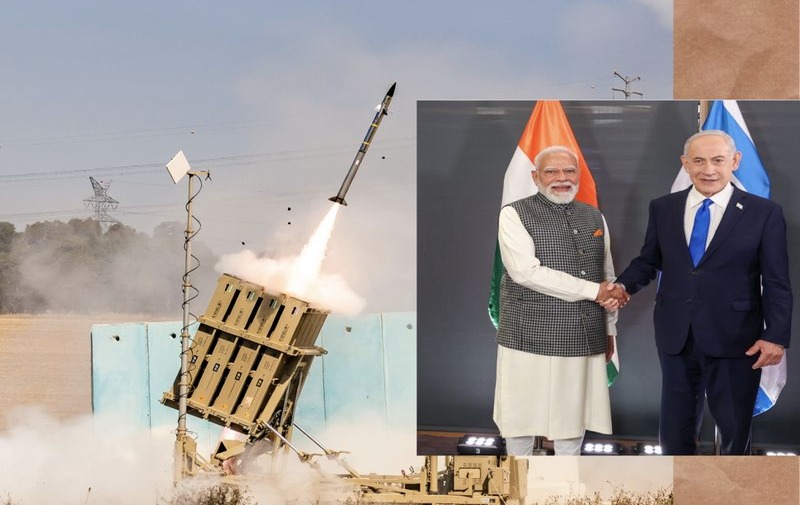
Imagine a missile launched toward a crowded city, and within seconds, another missile rises to destroy it mid-air before it can cause harm. That is the promise of the Iron Dome. Now, imagine that technology being built in India. During Prime Minister Narendra Modi’s recent visit to Israel, discussions reportedly intensified around expanding defence cooperation between the two nations. According to Israel’s Consul General Yaniv Revach, the talks are not about a simple arms purchase but about deeper collaboration, potentially including technology transfer of Israel’s renowned Iron Dome system under India’s ‘Make in India’ program. If this becomes reality, it would mark one of the most significant defence technology partnerships in modern Indian history.
The Iron Dome is a mobile, all-weather air defence system developed by Rafael Advanced Defense Systems and Israel Aerospace Industries. Operational since 2011, it is designed to intercept short-range rockets, artillery shells and drones before they hit populated areas. The system has three core components. The first is the EL/M-2084 detection and tracking radar, built by Elta Systems, a subsidiary of Israel Aerospace Industries. The second is the Battle Management and Weapon Control system, developed for Rafael by mPrest Systems, which calculates whether an incoming rocket poses a threat. The third is the missile firing unit that launches the Tamir interceptor missile to neutralise the threat mid-air. What makes Iron Dome extraordinary is its intelligence. It does not intercept every rocket. Instead, it calculates the rocket’s trajectory and fires only if the projectile is headed toward a populated or strategic area. This makes it both efficient and cost-effective. Israel claims a success rate of over 90 percent in intercepting rockets that threaten populated areas. Over the years, it has reportedly intercepted thousands of projectiles fired from Gaza, Lebanon and other fronts.
Reports suggest that discussions may not be limited to Iron Dome alone. Israel operates a sophisticated multi-layered missile defence architecture. This includes David's Sling for medium-range threats, the Arrow missile defense system for long-range ballistic missiles, and the laser-based Iron Beam, introduced recently to intercept drones and short-range threats. If India gains access to these technologies, it would significantly strengthen its defensive depth against modern aerial threats.
India faces a complex security environment. Its borders with Pakistan and China remain sensitive. Recent conflicts worldwide have shown how drones and precision missiles can disrupt military bases, infrastructure and even civilian life. India already operates advanced systems such as the S-400 from Russia and indigenous missile programs under DRDO. However, a system like Iron Dome could add a specialised layer designed specifically to counter short- and medium-range rocket threats and drone swarms. More importantly, the proposed collaboration would align with India’s ‘Make in India’ initiative. Instead of importing finished systems, India would potentially manufacture components domestically, develop expertise, and reduce long-term dependence on foreign suppliers. That is not just defence modernisation it is industrial transformation.
If Israel transfers the core technologies behind Iron Dome and possibly Iron Beam, it would represent an extraordinary level of trust. Historically, such high-level defence technology has been shared only with very close allies. Israeli Prime Minister Benjamin Netanyahu has spoken about deeper alliances in a changing geopolitical landscape. Meanwhile, Prime Minister Narendra Modi has consistently emphasised strategic autonomy and stronger global partnerships. Some analysts describe the move not as Israel “selling weapons” but as Israel “buying an alliance.” The logic is simple: when countries integrate their defence systems, they build long-term institutional relationships that go beyond political cycles. Maintenance, software updates, upgrades and threat intelligence sharing create deep structural bonds. For India, this could elevate its strategic partnership with Israel to a level comparable to Israel’s closest allies.
India and Israel have steadily strengthened defence ties over the past two decades. From surveillance drones to missile systems, Israel has become one of India’s key defence suppliers. But a full-fledged transfer of Iron Dome technology would take this relationship to an entirely new level, from buyer-seller to co-developers and strategic architects of shared security. In a world where aerial threats are evolving rapidly, nations are not just building weapons; they are building shields. And if the Iron Dome becomes part of India’s defence landscape built in Indian factories, operated by Indian forces, protecting Indian skies, it may not only revolutionise national defence but also redefine the meaning of strategic partnership in the 21st century.

Romanticizing life and shaping stories from everything I see through my journalistic lens. Also, I love sports on the side.