"Dream, Dream, Dream! Conduct these dreams into thoughts, and then transform them into action."
- Dr. A. P. J. Abdul Kalam
"Dream, Dream, Dream! Conduct these dreams into thoughts, and then transform them into action."
- Dr. A. P. J. Abdul Kalam
24 Dec 2025
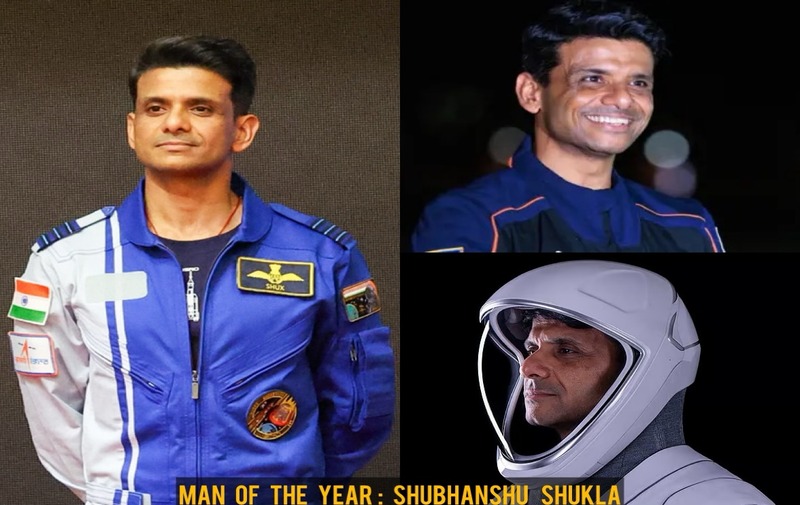
Group Captain Shubhanshu Shukla of the Indian Air Force has been honored as the Man of the Year by The Week magazine in its December 21, 2025, edition, recognizing his historic role as the mission pilot of Axiom Mission-4 (Ax-4) to the International Space Station (ISS). The recognition celebrates not just an individual achievement but a defining moment for India’s growing presence in global human spaceflight. The Indian Air Force officially congratulated Shukla, calling the honor a proud milestone for the nation and a significant boost to India’s long-term ambitions in crewed space missions.
Earlier this year, he was also named Science Icon of the Year by NDTV, acknowledging his contribution to advancing India’s presence in human spaceflight and inspiring a new generation of scientific ambition.
Axiom Mission-4 was the fourth private astronaut mission conducted by US-based Axiom Space in collaboration with NASA and SpaceX. The mission was launched in June 2025 aboard a SpaceX Crew Dragon spacecraft and docked successfully with the ISS. The mission marked the first-ever ISS visit for India, Poland, and Hungary, making it a historic flight not just for one nation, but for three.
With Ax-4, Shubhanshu Shukla became the first Indian astronaut to visit the International Space Station and only the second Indian to travel to space, following Wing Commander Rakesh Sharma’s iconic mission aboard Soyuz T-11 in 1984. More than four decades after Sharma’s flight, Shukla’s mission symbolized a generational leap, one that placed India firmly in the modern era of space exploration, private-public collaboration, and sustained human presence in orbit.
Originally planned as a 14-day mission, Axiom-4 was extended to 18 days, reflecting the mission’s success and operational stability. During his time aboard the ISS, Shukla conducted multiple STEM experiments, contributing to research in microgravity conditions. Equally important was his role as a communicator. Shukla documented daily life aboard the ISS and actively engaged with students, young scientists, and aspiring astronauts back in India, using live interactions and recorded sessions to inspire curiosity and confidence in science and exploration. His calm professionalism and clarity made space feel closer and more human to millions watching from Earth.
Born on 10 October 1985 in Lucknow, Shubhanshu Shukla’s journey is deeply rooted in discipline, determination, and inspiration. The youngest of three siblings, he grew up in a modest household with his father, a retired government officer, and his mother, Asha Shukla, a homemaker. Educated at City Montessori School, Shukla was deeply influenced by the Kargil War of 1999, which ignited his desire to serve the nation in uniform. That motivation led him to clear the prestigious National Defence Academy and Naval Academy examination. Shukla graduated with a Bachelor of Science in Computer Science from the National Defence Academy in 2005 and went on to complete his flying training at the Indian Air Force Academy. He was commissioned into the fighter stream of the IAF in June 2006. Over the years, he built a reputation as a skilled test pilot, earning the nicknames “Shux” and “Gunjan” among his peers. His operational experience and technical expertise laid the foundation for his selection into India’s human spaceflight program.
Shukla’s total time in space now stands at over 20 days, a figure that represents not just hours in orbit but decades of preparation, sacrifice, and national aspiration. His Ax-4 mission aligns closely with India’s future plans, including the Gaganyaan program and the proposed Bharatiya Antariksh Station. Officials see his successful mission as a confidence-builder, proving that Indian astronauts can operate seamlessly in international missions and complex orbital environments.
Being named The Week magazine’s Man of the Year is more than a personal honor for Group Captain Shubhanshu Shukla. It is recognition of a journey that connects classrooms to cockpits, fighter jets to space stations, and individual dreams to national ambition. For young Indians looking up at the night sky, Shukla’s story sends a powerful message that space is no longer distant and that with discipline, learning, and courage, even the stars are within reach.

Writing about what truly matters, good news and stories to remind the world - it is brighter than we think.