"Dream, Dream, Dream! Conduct these dreams into thoughts, and then transform them into action."
- Dr. A. P. J. Abdul Kalam
28 Nov 2026
Every time we use GPS to find a route or track a location, satellites rely on extremely precise timekeeping to send accurate signals. Even a tiny timing error can affect how accurately a receiver determines its position. Now, an Indian deep-tech startup is working to strengthen this crucial technology.
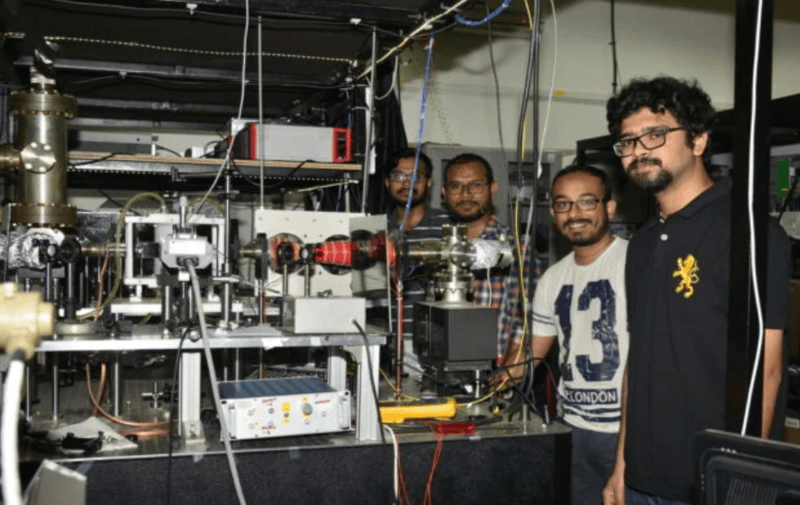
QuPrayog, incubated at the I-HUB Quantum Technology Foundation at the Indian Institute of Science Education and Research (IISER), Pune, has developed a laboratory-scale atomic clock using rubidium-87 atoms.
The startup completed the prototype in just seven months and is aiming to develop a miniature version by August 2027.
Unlike ordinary clocks that depend on electronic components, atomic clocks use the natural behaviour of atoms to maintain exceptionally accurate time. QuPrayog's prototype uses a technique called Coherent Population Trapping (CPT). In this method, carefully controlled laser light interacts with rubidium atoms to produce a highly stable frequency.
This frequency serves as a reference for the clock's electronic components, helping them maintain precise timing. The approach is different from conventional atomic clocks that use microwave cavities. By using light to interact with atoms, the technology could enable smaller clocks with lower power requirements and fewer complex components.
India is exploring navigation technologies based on Low Earth Orbit (LEO) satellites, which operate closer to Earth than traditional navigation satellites. These systems require clocks that are not only accurate but also compact, lightweight and energy-efficient.
Such technology could also support navigation systems designed to work when conventional GPS signals are unavailable or disrupted.
QuPrayog aims to reduce India's dependence on imported atomic clocks and develop a domestic supply chain for high-performance timing systems.
Founded in 2024 by Dr Jay Mangaonkar and Dr Rahul Sawant, QuPrayog is also incubated at the IIT Madras Incubation Cell. Its technology development receives support from India's National Quantum Mission, which promotes indigenous capabilities in quantum sensing and precision measurement.
The startup's next steps include improving the clock's performance, reliability and packaging before developing a smaller version. Its long-term plans extend to compact atomic clocks for satellite navigation, telecommunications and scientific instruments.
By bringing together atomic physics, laser technology and precision engineering, QuPrayog is working towards a future where India can build more of its own critical timing technology.
.jpeg)
I have a Masters in Literature and a knack for spotting the silver lining! When I’m not chasing good news, you’ll find me nurturing my farm or lost in a good book.