"Dream, Dream, Dream! Conduct these dreams into thoughts, and then transform them into action."
- Dr. A. P. J. Abdul Kalam
"Dream, Dream, Dream! Conduct these dreams into thoughts, and then transform them into action."
- Dr. A. P. J. Abdul Kalam
26 Feb 2026
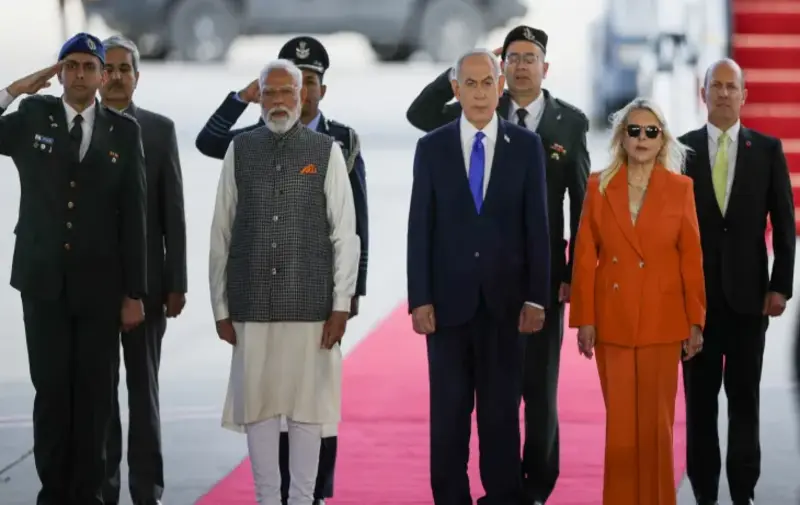
When Prime Minister Narendra Modi stepped onto the runway in Tel Aviv on February 25, 2026, the symbolism was immediate and unmistakable. Waiting for him was Israeli Prime Minister Benjamin Netanyahu. The two leaders embraced warmly, exchanging smiles that reflected not just diplomatic courtesy but personal chemistry. Moments like these travel far beyond airport cameras. In geopolitics, body language often speaks louder than communiqués. The embrace was not merely ceremonial; it underscored a relationship that has matured from cautious engagement into what both sides now describe as “special strategic relations.”

The centerpiece of the visit is Modi’s address to the Knesset plenum, making him the first Indian Prime Minister ever to do so. Scheduled during a special parliamentary session, the speech is more than a diplomatic honor. It represents India’s growing weight in West Asia and Israel’s recognition of India as a key global partner. The Knesset, Israel’s unicameral legislature of 120 members, is not merely a lawmaking body. It is the arena where governments rise and fall, where national debates unfold, and where the country’s democratic tensions are most visible. Addressing this chamber during a period of internal political debate over judicial reforms adds layers of complexity to the visit. For India, the moment is symbolic of how far relations have come since diplomatic ties were formally established in 1992. For Israel, inviting Modi to speak signals trust, alignment, and an acknowledgment of India’s growing geopolitical influence.
Modi’s 2017 Israel visit had already elevated bilateral ties to a strategic partnership. The 2026 visit appears designed to move beyond that framework. Israeli officials have framed this engagement as an upgrade akin to the status reserved for countries such as the United States and Germany. Defense remains the backbone of this relationship. Israel has emerged as one of India’s most significant defense suppliers, with cooperation spanning precision-guided munitions, missile systems, and advanced surveillance technologies. Israeli companies like Rafael Advanced Defense Systems, Elbit Systems, and Israel Aerospace Industries are central players in this growing military-industrial linkage. Yet this visit broadens the canvas. Both governments are emphasizing artificial intelligence, quantum computing, and cybersecurity as pillars of future cooperation. A joint cybersecurity center of excellence is expected to be announced, reflecting shared concerns over digital warfare and infrastructure vulnerabilities. As Netanyahu himself remarked, AI and quantum are not the future; they are the present. This framing reflects how both nations see technological sovereignty as integral to national security.
The choice of venue for key engagements, the historic King David Hotel, carries its own diplomatic symbolism. For decades, the hotel has hosted pivotal negotiations and world leaders. Hosting expanded bilateral talks and agreement signings here ties Modi’s visit to Israel’s broader diplomatic history. Agreements expected during the visit span science and technology, agriculture, renewable energy, academic exchange, and financial cooperation. Israel’s cabinet has already approved significant funding to strengthen ties, including the establishment of new centers of excellence in India. The push toward a Free Trade Agreement adds an economic dimension that could reshape trade flows. If concluded within the year, it would mark one of the most consequential trade alignments in the region.
On February 26, Modi is scheduled to visit Yad Vashem, Israel’s Holocaust memorial. Such visits are standard in state diplomacy, but they are never routine. India’s connection to Holocaust history is less widely known but deeply meaningful. During World War II, India provided refuge to Jewish families fleeing persecution. Indian soldiers serving in the British forces also participated in campaigns that helped liberate concentration camps in Europe. By laying a wreath at the Hall of Remembrance, Modi reinforces not only diplomatic solidarity but also a shared acknowledgment of historical suffering. In geopolitics, memory shapes alliances. Acts of remembrance humanize statecraft.
India’s relationship with Israel must also be understood within the broader framework of its West Asia policy. New Delhi maintains strong ties with Arab nations, including energy partnerships and a large Indian diaspora across the Gulf. Modi’s Israel visit does not signal a departure from that balance but rather demonstrates India’s strategic autonomy. New Delhi has consistently sought to engage all sides—Israel, Gulf states, and Iran—based on pragmatic national interest rather than ideological alignment. In a region defined by shifting alliances and conflicts, India’s approach reflects a multi-vector diplomacy. By strengthening ties with Israel while maintaining relations across the Arab world, India positions itself as a stable, independent actor.
The address to the Knesset will be closely watched not only for its diplomatic tone but also for how it navigates Israel’s domestic political tensions. Whether it becomes a defining statement of shared democratic values or is overshadowed by local debates may shape perceptions of the visit. Yet the embrace on the runway already conveyed something fundamental. This is not merely a transactional partnership; it is a relationship rooted in strategic calculation, technological ambition, and personal rapport between leaders. In geopolitics, history often turns on moments that appear simple—a handshake, a speech, a wreath laid in silence. Modi’s 2026 Israel visit may well be remembered as one such moment, marking the consolidation of a partnership that extends far beyond ceremony into the architecture of 21st-century global power.
Romanticizing life and shaping stories from everything I see through my journalistic lens. Also, I love sports on the side.