"Dream, Dream, Dream! Conduct these dreams into thoughts, and then transform them into action."
- Dr. A. P. J. Abdul Kalam
"Dream, Dream, Dream! Conduct these dreams into thoughts, and then transform them into action."
- Dr. A. P. J. Abdul Kalam
5 Dec 2025
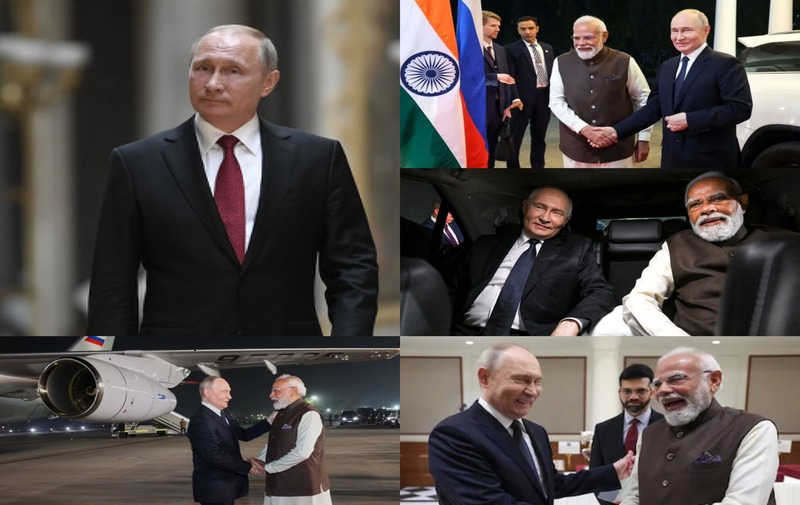
Russian President Vladimir Putin’s two-day visit to New Delhi, which began on Thursday night, has placed India at the centre of global diplomatic attention. Prime Minister Narendra Modi welcomed Putin for the 23rd Annual India-Russia Summit, an event carrying weight far beyond ceremonial gestures. This summit is unfolding at a time when India faces unprecedented tariff pressure from the United States over its energy ties with Moscow, making Putin’s visit not just significant but strategically charged. This is Putin’s first visit to India since the Ukraine war began in February 2022, and it arrives at a sensitive moment in the global geopolitical landscape. For India, which continues to balance its relationships with major world powers, this visit is a test of diplomatic resilience and strategic independence.
Putin’s arrival at Delhi’s IGIA Airport late on Thursday was marked by a gesture that made headlines. Prime Minister Narendra Modi broke protocol and personally welcomed the Russian president with his signature warm embrace. It was a moment that symbolized not only diplomatic goodwill but also a deep-rooted partnership built over eight decades. From the airport, Putin travelled not in his famed ultra-secure “Fortress on Wheels,” but in a humble White Fortuner to PM Modi’s residence at 7 Lok Kalyan Marg. There, the two leaders shared a private dinner, a gesture of personal warmth often missing from formal diplomatic visits. For many Indians watching the interaction, the moment felt reassuring, almost reminiscent of two old friends reconnecting despite the world around them becoming more complex.
Putin’s schedule today reflects the immense weight and urgency of his India visit, unfolding through a series of tightly packed events that highlight the depth of the bilateral relationship. The day begins at 11:00 AM with a ceremonial reception at Rashtrapati Bhavan, where President Vladimir Putin receives a traditional welcome that underscores Russia’s longstanding role as one of India’s most trusted strategic partners. At 11:30 AM, he proceeds to Rajghat to lay a wreath at Mahatma Gandhi’s memorial, a gesture that ties Russia’s leadership to India’s moral and historical values, showing respect for the nation’s founding principles. Shortly after, at 11:50 AM, the most crucial part of the visit unfolds at Hyderabad House, where Putin and Prime Minister Narendra Modi engage in high-level summit talks expected to shape the future of defence cooperation, civil nuclear energy collaboration, and bilateral trade expansion. By 1:50 PM, the two leaders appear for joint press statements, a moment the world will watch closely for announcements on energy partnerships and agreements designed to shield India-Russia ties from escalating Western pressure. Later in the evening, at 7:00 PM, Putin meets President Droupadi Murmu at Rashtrapati Bhavan, marking a significant state-level interaction that reinforces India’s respect for Russia as an enduring global ally. Finally, at 9:00 PM, Putin concludes his nearly 27-hour visit, departing after a day that may be brief in hours but carries enormous diplomatic significance for both nations and the evolving global order.
Putin’s visit comes at a time when India’s long-standing energy partnership with Russia is being tested. The United States, under President Donald Trump, has recently imposed a steep 50% tariff on all Indian goods, including a 25% levy specifically linked to India’s purchase of Russian crude oil. Despite these pressures, Russia remains India’s largest supplier of seaborne oil. In an interview with India Today, Putin emphasized that Western sanctions have not significantly impacted energy cooperation with New Delhi. His statement reflects the enduring nature of Indo-Russian ties, especially during global turbulence. For India, Russian oil is not just an economic choice it is a lifeline for managing inflation, stabilising fuel prices, and keeping the economy running smoothly for millions of citizens.
Russia has been India’s biggest defence supplier for decades, and today’s talks will likely reinforce that foundation. New Delhi is keen to safeguard upcoming defence projects, jointly develop military technologies, and ensure that existing supply chains remain unaffected by geopolitical disruptions. Another major focus is civil nuclear energy, including discussions on small modular reactors, a future-forward area where India sees immense potential. Trade, too, is set for expansion. Russia wants to significantly increase imports of Indian goods in order to balance a trade relationship currently dominated by India’s energy purchases. The goal is ambitious: achieving $100 billion in bilateral trade by 2030.
Beyond the policy papers and diplomatic photo-ops, this visit holds a human connection. Affordable fuel affects everything from the vegetable vendor transporting goods across states to families planning their monthly budgets. Defence cooperation ensures the safety of millions of Indian soldiers who rely on Russian-origin equipment and spare parts. Trade expansion means new markets for Indian farmers, manufacturers, and small businesses. In a world growing more polarized, India’s ability to maintain friendships on all sides is not just a diplomatic achievement; it is essential for the everyday stability of its people. As President Vladimir Putin and Prime Minister Narendra Modi meet today, the outcomes will influence India’s energy security, defence preparedness, trade priorities, and foreign policy direction for years to come. On this December 5, New Delhi does not simply host a world leader. It hosts a moment that may redefine global power equations and India’s place within them.
Romanticizing life and shaping stories from everything I see through my journalistic lens. Also, I love sports on the side.