"Dream, Dream, Dream! Conduct these dreams into thoughts, and then transform them into action."
- Dr. A. P. J. Abdul Kalam
"Dream, Dream, Dream! Conduct these dreams into thoughts, and then transform them into action."
- Dr. A. P. J. Abdul Kalam
24 Aug 2026
Even on days when the sky is cloudless and rain seems nowhere in sight, the atmosphere still contains water vapour.
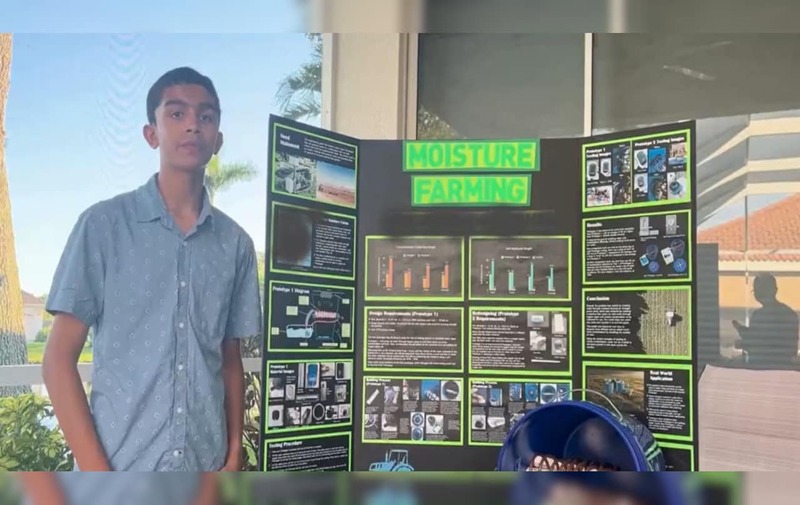
For 13-year-old Aniket Sarkar, that invisible moisture sparked a fascinating question: Could some of it be captured and used to help farmers facing water shortages?
His answer is an early-stage, low-cost atmospheric water capture system built using ordinary materials. Designed with farmers in dry parts of the American Midwest and West in mind, the prototype explores whether moisture from the air could supplement conventional water sources.
It is not yet a finished agricultural technology, but the young inventor has already demonstrated something important—the ability to turn an environmental challenge into an engineering experiment.
Farming in regions with unreliable rainfall or limited water supplies can be a constant challenge. Groundwater, reservoirs and rainfall remain crucial, but Aniket’s project looks at an often-overlooked resource: the moisture floating invisibly in the atmosphere. The principle sounds simple. Capture water vapour from the surrounding air and convert it into usable water. Making that happen efficiently, however, is far more complicated.
Humidity, temperature and weather conditions can dramatically affect how much water can actually be recovered. A system that performs well in one environment may produce very different results in another.
That is precisely where Aniket’s experimentation comes in.
Rather than waiting for sophisticated laboratory equipment, Aniket developed his prototype using simple, accessible components. The approach allowed him to experiment with the concept, observe how the different parts worked together and identify areas that could be improved.
He later entered the 3M Young Scientist Challenge, giving him an opportunity to showcase his invention and continue developing his thinking around the technology. For a project still in its prototype stage, the experience could be particularly valuable. Guidance from experienced mentors and exposure to other young innovators can help transform an intriguing idea into a more refined design.
Aniket’s interest in water innovation is part of a broader fascination with STEM, robotics and rocketry. His experiences in these fields have encouraged him to approach real-world environmental problems from an engineering perspective. His ambition extends well beyond this one prototype. Aniket hopes to become an environmental engineer and contribute to solutions for some of society’s most pressing challenges, including those linked to climate change.
His atmospheric water project may still be at the beginning of its journey. But sometimes, groundbreaking ideas begin with something remarkably simple—a question asked by a curious young mind.
.jpeg)
I have a Masters in Literature and a knack for spotting the silver lining! When I’m not chasing good news, you’ll find me nurturing my farm or lost in a good book.